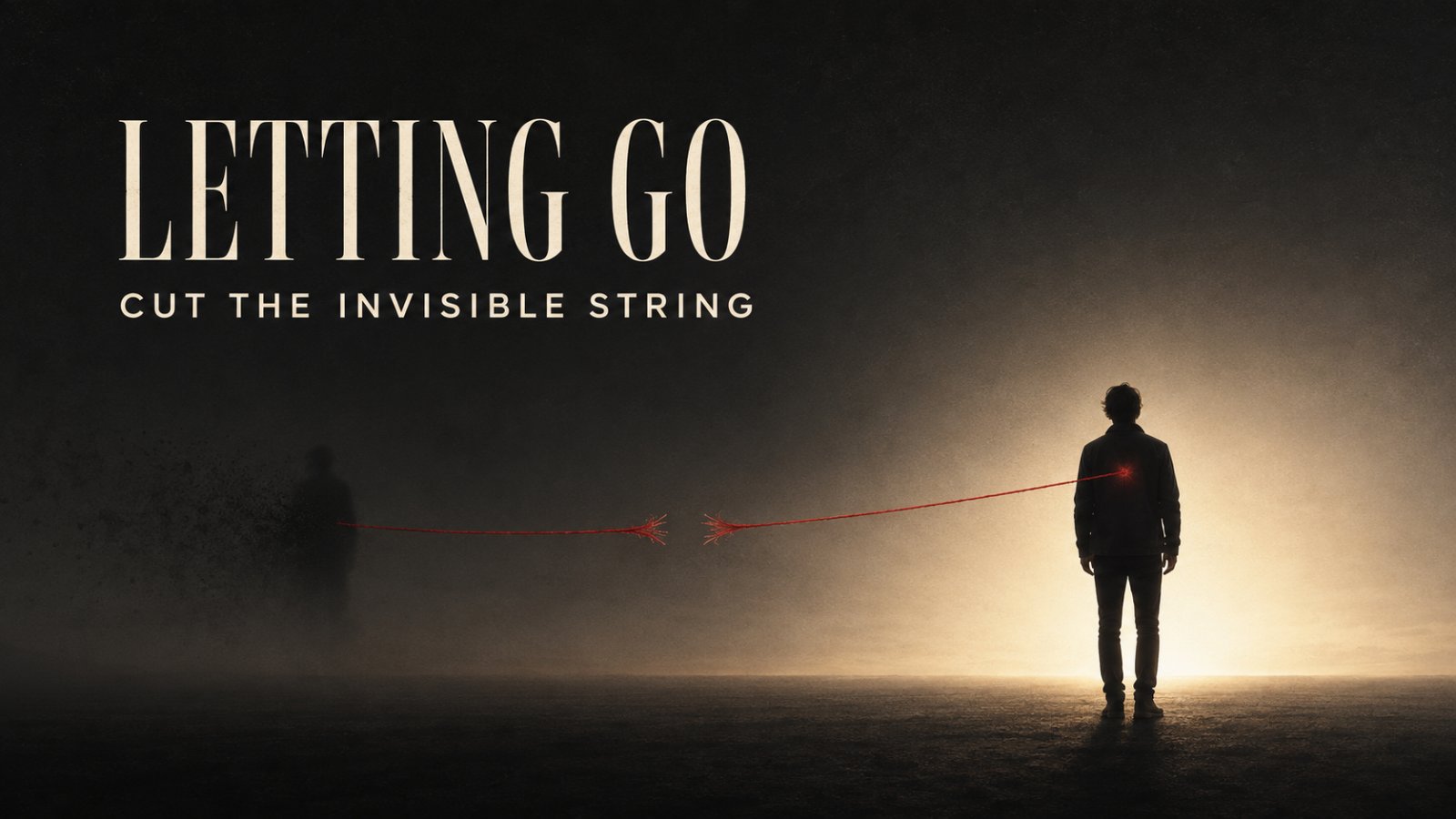
Cut the Invisible String Before It Becomes Your Identity
You think you are holding on to what they did. In truth, what they did is holding on to you. It may have begun with a single moment: a cruel word, an unexpected betrayal, a humiliation no one else witnessed, or a promise broken without apology.
Someone wounded you, and something rose inside you. Anger surged through your body. Frustration tightened your chest. Your mind raced to defend itself. You reacted with words, silence, withdrawal, accusation, or a smile that pretended nothing had happened.
The moment ended, but the emotion remained. It sank beneath the surface and settled in the soul like sediment at the bottom of a lake. Then life moved on. The calendar turned. Seasons changed. People forgot. The person who hurt you continued living.
But your soul remembered.
From that unresolved emotion, an invisible string was formed. One end attached itself to you. The other attached itself to them.
The String You Cannot See
Every time you replay the offense, another strand is added. Every imaginary confrontation strengthens it. Every time you tell the story and feel the original fury rise again, the string tightens. Every time you wonder whether they are suffering yet, you pull them closer.
They may have moved to another city. They may have left your family, workplace, church, or life. They may no longer speak to you. They may not have thought about the incident in years. But emotionally, they are still near. They remain in your orbit.
You wake up with them. You carry them into conversations. You compare your life with theirs. You hear their voice in the words of innocent people. You bring them into your marriage, parenting, leadership, and friendships. They are absent from the room, yet they continue influencing its temperature.
This is the hidden power of resentment. It keeps people present long after they have physically departed. The person may have hurt you once, but memory can hurt you a thousand times.
When the Person Who Hurt You Flourishes
Then something even more painful happens. You see them flourishing. They are laughing, traveling, receiving promotions, growing their business, and being celebrated by others. Their family appears happy. They walk through life as if nothing happened, while you are still trying to breathe beneath the weight of what they did.
It feels unbearable. You wonder, How can they be so free while I am still suffering? How can they sleep peacefully when they stole my peace? How can they prosper after what they did to me? Their happiness begins to feel like an insult. Their success feels like evidence that justice has failed.
So you watch them more closely. You study their life for signs of trouble. You listen for rumors of collapse. You wait for the day when consequences finally knock on their door. Without realizing it, your resentment has become surveillance. You are monitoring their life while neglecting your own.
But what if they never apologize? What if they never acknowledge the damage? What if they appear to flourish for the rest of their lives? Will you remain imprisoned until they collapse? Will you postpone your healing until they suffer? Will you give the person who wounded you the authority to decide when you are allowed to live again?
Your freedom cannot depend on their failure. Your healing cannot wait for their apology. Your peace cannot remain chained to their punishment.
You Are Not Punishing Them
Resentment creates a terrible illusion. It convinces us that holding on is a form of justice. We imagine that our anger is somehow holding the offender accountable.
But they may not feel the string at all. They may be eating dinner, laughing with friends, sleeping peacefully, and planning their future while you are replaying a conversation from ten years ago. You are not disturbing their sleep. You are disturbing yours. You are not poisoning their future. You are poisoning your present.
You are not imprisoning them in your anger. You are imprisoning yourself. Resentment is like swallowing poison and waiting for someone else to become sick.
The tragedy is not merely that they hurt you. The greater tragedy is that what they did is still being permitted to shape you. They committed the original offense, but every time you rehearse it, you give that offense another opportunity to enter your body, disturb your emotions, and redesign your character.
They wounded you once. Now the wound is teaching you how to wound yourself.
The Soul Keeps What the Mouth Never Releases
The most dangerous anger is not always the anger that explodes. Sometimes it is the anger that deposits. A layer of humiliation settles here. A layer of rejection settles there. Then come disappointment, suspicion, grief, envy, and bitterness. One deposit may not transform us, but life rarely gives us only one.
Eventually, yesterday’s wound begins interpreting today’s conversation. An innocent question sounds like criticism. A delayed response feels like rejection. Correction feels like an attack. Someone else’s success feels like a personal insult. Love becomes difficult to trust because trust once became expensive.
The person standing before us may not have created the original wound, but they are forced to interact with the person that wound created. This is how pain travels. It enters through one person and eventually exits through another.
Children inherit tensions they never caused. Spouses pay debts they never incurred. Employees absorb the anger of leaders who once felt powerless. Congregations suffer beneath the insecurities of wounded leadership. One generation bleeds, and the next generation learns to call the stain a family tradition.
Pain may explain our behavior, but it cannot excuse the pain we inflict on others. What we refuse to heal, we eventually hand to someone else.
Your Brain Is Learning From What You Rehearse
This transformation is more than poetic. Repeated thoughts can influence the physical pathways of the brain. Through neuroplasticity, the brain adapts to repeated attention, experience, and activity. Frequently used neural pathways can become easier to activate. The brain becomes increasingly efficient at traveling the roads we use most often.
Imagine walking across an untouched field. The first crossing is difficult. Tall grass catches your feet. The ground is uneven, and there is no visible path. Walk across it every day, and eventually the grass bends beneath your steps. The soil hardens. A trail appears. After enough time, you no longer search for the way because your feet naturally follow the path.
Repeated resentment can create a similar emotional route. One disappointment activates an entire history. One careless word opens an old highway. Before you realize what has happened, you have traveled miles into a familiar country of anger, suspicion, and self-pity. Soon, you are no longer consciously choosing the road. The road is choosing for you.
This is why what you dwell upon matters. Attention is not passive. Attention is construction. What repeatedly occupies your mind begins shaping how you interpret people, anticipate danger, and respond to life. Your thoughts do not merely pass through you. Repeated thoughts can build pathways within you.
You are not simply thinking thoughts. Your thoughts are shaping the thinker.
We do not become bitter in a single afternoon. We become bitter through thousands of private rehearsals. We remember the offense, retell the story, feel the fury, and imagine their downfall. Every repetition waters something. The question is not whether something is growing inside you. The question is what.
When Pain Becomes Personality
Character changes like a tree grows. No one hears the roots pushing through the soil. No one sees the trunk widening from one day to the next. Yet years later, the sapling has become something enormous. The same thing happens within us.
An emotion becomes a pattern. The pattern becomes a habit. The habit becomes a disposition. The disposition becomes character. Then character begins producing the future.
After enough time, people stop seeing the wound. They see what they believe is your personality. They conclude that this is simply how you are, that you do not trust anyone, that you take everything personally, or that you have always been angry.
But perhaps that was not always who you were. Perhaps the coldness began as protection. Perhaps the controlling behavior began with betrayal. Perhaps the rage began with humiliation. Perhaps the silence began when speaking once carried a terrible cost. What others call personality may be accumulated pain that was never confronted.
Your wound does not deserve to become your identity. The worst thing someone did to you does not have the right to become the most powerful thing about you.
Cut the String
Letting go is the moment you cut the invisible string. It does not mean the offense was acceptable. It does not erase the truth, remove accountability, or require you to restore access to someone who remains dangerous. It does not mean reconciliation is always possible.
Forgiveness removes the poison. Boundaries remove access. Accountability names the damage. You can forgive someone and still lock the door. You can release someone and still tell the truth. You can surrender revenge while allowing consequences to unfold.
Letting go means refusing to let what happened continue governing what happens next. It means declaring, You injured me, but you will not design me. You affected my past, but you will not own my future. What you did will remain part of my story, but it will not become the author of my character.
As long as someone remains attached to you, you may still be cushioning them with your goodness. You explain their behavior. You cover their failures. You rescue them from consequences. You monitor their life. You spend emotional energy trying to stabilize a person who keeps destabilizing you.
Releasing them means you stop using your life as their life-support system. You do not curse them or push them toward destruction. You simply stop standing beneath what they refuse to carry.
Once released, their trajectory belongs to them. They may repent. They may change. They may face consequences. They may continue flourishing. They may eventually implode beneath the weight of their own choices. But that is no longer yours to manage.
You return them to God. You release them from your orbit. You stop allowing their gravity to bend the direction of your life. Their future becomes their responsibility, and yours becomes yours again.
Let God Handle What You Cannot
Scripture warns us about the “root of bitterness” because bitterness never remains where it begins. Roots travel underground. They spread invisibly. Then they emerge in places far from the original wound.
God does not command us to release vengeance because the injury was insignificant. He commands us to release it because vengeance is too heavy for the human soul to carry without becoming deformed. “Vengeance is Mine,” says the Lord.
That does not mean injustice is ignored. It means you are no longer required to be the judge, jury, prison guard, and executioner inside your own mind. You put down the gavel. You leave the courtroom. You surrender the case to God.
The renewal of the mind begins when we examine the thoughts that have been circling within us. Is this thought true? Is it producing wisdom or preserving anger? Am I remembering this to learn, or rehearsing it to suffer? Is this emotion warning me about something that must be addressed, or have I begun feeding it? What kind of person will I become if I continue thinking this way for another ten years?
That final question may terrify you. Let it awaken you. A deeply worn pathway is not sacred. You do not have to keep walking it.
The same mind that rehearsed resentment can practice gratitude. The same imagination that staged revenge can envision healing. The same voice that repeated the offense can begin declaring truth. The same heart that became hardened can become tender again.
Do It Before Another Year Disappears
Name the person. Name what happened. Do not minimize it, excuse it, or pretend it did not hurt. Grieve honestly. Establish the boundaries wisdom requires. Seek help if the wound is too deep to carry alone.
Then say what your soul has needed to say: I release my demand to see you suffer before I allow myself to heal. I release my need for an apology before I begin living again. I will not carry you into another year. I will not give your actions another day of authority over my character. I return you to God, and I reclaim the future He has given me.
Then cut the string.
Stop checking on them. Stop rehearsing the offense. Stop reopening the courtroom. Stop imagining conversations that will never happen. Stop measuring your life against theirs. Stop watering the moment that wounded you.
They have occupied enough space. They have consumed enough time. They have influenced enough relationships. They have lived inside you long enough.
Open the windows of your soul. Let truth enter. Let grace enter. Let God enter every room you locked after the injury.
You may have carried the weight for so long that putting it down feels like losing part of yourself. But the weight is not you. The anger is not you. The betrayal is not you. The rejection is not you. The wound is something that happened to you. It is not who you were created to become.
Let the experience leave wisdom, but release the bitterness. Let betrayal teach discernment, but release suspicion. Let rejection deepen compassion, but release self-hatred. Let failure produce humility, but release paralysis. Let the scar remain if it must, but remove the infection.
You cannot change what happened yesterday, but you can decide what it will produce tomorrow. The greatest victory may never be watching the person who hurt you receive what they deserve. The greatest victory is looking into your own soul and realizing they no longer have the power to decide who you become.
Cut the string. Release them. Then turn toward the life that has been waiting for you to return.